Blogs Directory Business Directory Visit BlogAdda.com to discover Indian blogs 1Abc Directory
Best Business Web Directory
Showing posts with label Insurance. Show all posts

Saturday, November 17, 2018

COCODrive by DHFL GI offers Comprehensive CAR insurance, tailor-made for individual needs

Offers a-la-carte #Comprehensive Car Insurance with 19 add-on covers to choose from 

Vehicle insurance is the only insurance in India which is mandatory. Whether you understand it or not, by default your Car dealer will push you to an insurance agent for buying a car insurance policy, the moment you buy a car. It is almost an automated process of signing the dotted lines without understanding the need, requirement and viability of that product and services. The mandatory third-party insurance doesn’t cover many facets, hence a comprehensive Car Insurance is recommended for the unique need an individual may have.

Though insurance companies provide #Comprehensive Car insurance, it may or may not cover the requirement which suits your need.


 In its bid to provide car owners with best possible solution, COCO by DHFL General Insurance identified the unique needs of the customers and recently launched their comprehensive four wheeler insurance called COCODrive, using Artificial Intelligence, machine learning and various other underlying technologies. With an hyper-customisation approach, they have come up with a slew of 19 add –on covers depending on the set of unique requirements an indvidual may have, depending on the vehicle model, the usage, location and individual priorities. Unlike other insurers, COCODrive doesn’t offer 6/7 add-ons bundled in an ad-hoc manner inorder to complete the buying process reduced into a a few minutes affair and neither does COCO encourage third party dealer led sales that leave customers confused.


With an A-la-carte approach, COCO by DHFL GI encourages customers, vehicle owners to buy this online Car Insurance taking some time understanding the product and how one can take maximum benefit out of it. The personalized car insurance product  encourages car owners to understand each add-on  one can choose from under this  comprehensive car policy and also the common exclusions under vehicle insurance which helps customers get the best deal for the best cover. The aim of the insurer here is to simplify the insurance process and making it an engaging and customer friendly experience, along with reducing the chance of issues  when it comes to claim settlement.
To make the process easy  and hassle-free, the claim settlement process has been made simpler. A customer can click a few pictures of the damaged car and initiate the claim –settlement process himself/herself.   

Listing down the  19 add-on features one can choose from. The choice can be made  as per your requirement. These are too informative to not mention here in this post.
This CAR Insurance is definitely a life-saver as the add-ons include - Zero Depreciation insurance (recommended for new cars upto 5 years), Key & Lock Replacement (recommended for expensive cars), New Car for Old Car, Tyre Replacement Cover, Consumable Expenses as well as Engine Protect option (recommended for flood prone area).

The insurer knows that its not only the car, because an accident costs much more than that for an individual/ familyr. COCODrive has introduced EMI Protector, Outstanding loan protector, Accident Hospitalisation costs, Enhanced Owner Personal Accident, Enhanced Paid Driver Personal Accident Enhanced occupants cover, Hospi cash,  Personal Belonging Protector etc. The damage a family may suffer due to an accident may be very painful, but the insurer is aiming to provide a 360 degree coverage to protect the customer from an unforeseen tragedy.

COCODrive also provides other additional, non-standard add-on covers which may be equally important for some – The personal beloning cover, Road side assistance, daily conveyance, emergency travel and hotel stay, NCB Protector for non-metalic repairs and NCB protector cover etc.
Finally, I came across as a product which would have answer for every query and a solution for every worry a car owner may have. A thumbs to COCODrive by DHFL General Insurance by MyMoneyStreets

You can visit their website at: www.dhflgeneralinsurance.com 

Monday, April 16, 2018

The good side of the endowment plans which can be used smartly

I would like to call myself a rational person who likes to be without bias and greed. Well with a bit too much of rationalistic approach, I found myself actually biased towards 'being rational.' I can call myself rationally biased towards my investment choices, aggressive allocation of equity on portfolio and staying away from debt heavy instrumemts, especially the fixed deposits for short term amd endowment plans for long term to be specific. Well, that fits well with my current age, but that is not the only way to look at long term investing. Endowment plans fits perfectly for a set of investors based on their risk profiles, investment objective, personal choice and priorities. Endowment plans stand out in long term debt investments. 

Though I like aggressive equity allocation for long term, with all humility I will accept that endowment as on today stands equal with the other long term debt products in various ways. Endowment plans have always have been a popular insurance cum savings product in India, credit goes to the hefty commission the insurance agents receives from the insurance companies for decades. My personal opinion have been rationally biased against it because of its lack of transparency on asset allocation, high agents commission, low coverage and low returns. The fact which bothered me the most is the "miss-selling". You may think, if I have so many rational points against the endowment plans, why I am even writing this post and what is my agenda? You will come to know. 

source - Wikipedia

With my first job, I joined the bandwagon of mutual fund investing, as the mutual funds investments were just picking up at fast pace, SIP was gradually getting introduced as a disciplined way of investing, superior tax-free return over long term was very attractive. And I hated the Endowment plans. I do have a active policy, I bought this one before I signed my first joining letter. Every time I paid the premium, I felt irritated about what a waste of my hard earned money until... until the 'D' day 2018-19 union budget struck hard on my equity dreams. Levying 10% tax on my artistically built equity portfolio on long term capital gains hit hard on my mind. It wasn't that the few other factors were not coaxing me to have a rational look at endowment plans and completely reject it, but the budget day nailed it. Budget not only introduced tax on long term capital gains, it also introduced 10% tax on dividends of equity and mutual funds. The equity dreams came crashing momentarily for many of us.

I recalled my father's advice, my boss's suggestion, inflation numbers and newly introduced Long-term-capital-gain-tax. In a whole it did push me to give a thought about taking a rational look at the cost and return analysis. 

While my view of equity being the best investment for long-term capital growth remains the same, endowment plans have made a special space for itself. Here is the list of things you get as benefits of endowment plans.

1. Life cover, as per IRDA regulations, insurance companies have to give a minimum 10 times life cover of annual premium, so at given point during the policy term you have a life cover, which is upto 20 times incase of endowment plans. For a 10 thousand yearly premium, you will be covered for about Rs. 2 lakh. The maturity value will be the accumulation of premium and interest earned from various instruments as the insurance company deplys the same to generate return. 

2. Income Tax benefit under section 80c. This product gives you tax benefit under income tax, the yearly premium can be calulated to reduce the income tax burden. 

2. Loan against insurance at a minimum interest rate - This is an interesting benefit which mutual funds, ULIPs or term insurance plan can't provide you. This instrument can be used as a collateral for an emergency loan if required, the loan amount and eligibility will depend on how long are you invested in the policy. Few people in my circle were immensely benefitted during medical and business emergencies. 

3. At the current interest rates, the return of 4-4.5% tax free is equivalent to the post tax fixed deposit returns. Also,there are no long term fixed deposit schemes over 10 years tenure in India. Over the years, India is moving towards low tax regime, which means in coming years the interest rate could go well below 5%. Endowment plans could give equivalent returns.

4. Tax-free return of accumulated corpus. This is a bonus. Given the recently launched LTCG, very few instrument like PPF and Life insurance.

This option is ideal for individuals above 45 years of age, as financial planners suggest reducing the equity exposure gradually and look for fixed income options. This option is also applicable for people in the highest tax bracket, as the post tax return on Fixed deposits are equivalent to the maturity value of a long-term endowment plans.  

This is a viable option for somebody who dont like equity investments, above 45 and looking at saving a corpus for retirement. Individuals with 30% tax bracket bracket can also consider the same as a long term FD with a provision of getting loan and tax exemption at maturity with life cover. However, One should keep a low exposure given its low return. For savvy investors, Term insurance and ULIP are good product which has a low cost structure and puts your money to good use maximising your profits.

To maximise the benefits, you should ask your insurance agent to pass on some cash benefit to you by paying first two premiums. This is a negotiable deal you can broke with the agent.

Kindly note that endowment plan should be bought only for long term  like 20 years and above. Endowment plans attract heavy penalty on missing due dates for premium, surrender pre-mature and may close the policy if policy-holders consecutively  misses premium payments. Also, it is an illiquid inveatment as one cannot withdraw the investments before its maturity or policy-holder's death. If one doesnt continue paying premium upto atleast 3 years, the investors will not get any return on the investments. Also, this may give very low or no inflation adjusted return given India's average inflation rate is about 5%.

THIS POST IS FOR EDUCATIONAL PURPOSE, AND NO WAY I AM PROMOTING ENDOWMENT PLANS AS TOP CHOICES FOR INVESTMENT FOR EVERYBODY, THIS IS APPLICABLE TO SELECT SET OF INDIVIDUALS, THIS ARTICLE IS JUST A RATIONAL LOOK AT ENDOWMWENT PLANS. TAKE A CALL ANALYSING YOUR FINANCIAL POSITION

Sunday, April 1, 2018

Dont be a financial fool - a suggestion on April Fool's day!

Step by step guide to buy ULIPs
Few days back I came across a news report on Rahul Dravid being conned by an entity on investments. A firm promised him more than 40% return on investments and duped him of crores. While I don't feel surprised when I hear my housemaid or my neighbor aunty are miss-sold a chitfund or endowment plan, Rahul Dravid, the ace cricketer known for his perfect calculation on field being conned, came as a big shocker to me. Shocked to know that a person who is a millionaire or even a billionaire on his own right who can afford a personal Charterd accountant or even a team to take care of his finances can fall in this trap. The point to note here is anybody can fall into this trap. These frauds in the name of ponzi, misselling wrong products and false promises has been existing since long. It is likely to continue in some form or the other. The point we should focus here is to catch it before it traps us. These wrong investments have a patern to it. If we learn the pattern and ask few questions, we can save ourselves from being cheated and a lot of mental agony along with it. Let me give you some points to ponder over.

It should strike if someone guarantees you high referral bonus, guarantee high returns, or kickbacks on your investments etc. The best way to identify and handle these, is stick to wellknown finanicial products, well known financial advisors and brokers and well known financial institution. Though there are numerous online frauds available, these fraudster may knock your door and call on your cell-phone, to give you a more genuine feel to it. Financial fraud is not limited to running away with money, it inculdes misselling as well. Be clear about investment objective and expected return. Do little bit of calculation and follow few steps to safeguard yourself.

These are the traps, however, there is no harm in double checking and being assured of you are not duped.   Whoever is the seller few points you definitely need to check before you say "yes"
So, take few steps and varify -

1. Google it - if it is a genuine company, or even false, it will have  a website or some online listing. If it doesn't have no internet presence, don't even bother looking at it. 


2. Do a little search - if you find the company name, check for the results its throwing up. Check for reviews. Reviews will guide you a bit.

3. Ask for the business model - no, you are not getting personal. If you are asked to invest 1 lakh rupee and assured of a 50% return in one year, you must know the source of the return. Any fixed deposit in India will not give 10% return if bank rates are hovering around 7%. Equity related investments have a potential of giving higher return.

4. Dont be emotional fool - last week my young cousin had a query that if I would like to buy an insurance product from her, a specific product which is her target. She was told by her bosses that it was the best seller product. Mind you, I am talking about a very very reputed company. I felt helpless. I was astonished to see it was a high cost endowment plan. I really wanted to help my little sis. And she wasnt working with the insurance company, but the retail broking wing. So, I offered to buy some mutual funds worth 4 times her target, incase it helped her. But to my surprise, the company refused to consider it. If I were not aware of the product features, I would have simply bought the insurance to make my sister happy, which is nothing but highest level of misselling. My sister is matured and understanding :-) but dont comit this mistake.

5. Call on that toll-free no. - It takes few minutes. Whichever financial product you are buying, in the brochure you will find a customer care no. Call up and verify the commitment s your broker made it you. Tally the benefits. If it suits you and if it completely match, you are quite safe.

Read, google, compare and ask experts on forums like Quora etc to make an informed decision. This financial year has brought in many changes, look forward to sharing updates and insights on them. Stay invested  Stay happy. 


Wednesday, March 21, 2018

Plan your Life Goals with ULIP. Chapter 2 – How to invest


how to buy ULIP, Invest in ULIP, Save tax with ULIP, Bajaj Allianz G
Test Case – Bajaj Allianz Goal Assure, Step-by-step guide to invest in ULIP

Hi Friends, I have taken it up as my resolution for this year to guide or help you with step by step process of various investment options. To name a few would be how to make fixed deposits, how to buy life insurance, how to buy mutual funds etc. On this blog post, I would like to focus on the emerging life insurance cum investment products, which in recent times have gone through many upgrades, to promise superior return on investments for long term (10 years and above).

ULIPs are not only a convenient investment solution; they also offer tax benefits under 80c.
For a test case, I am choosing the newly launched BajajAllianz Goals Assure. Three reasons I have chosen this investment solution:it’s the latest ULIP plan which boasts of minimum cost structure of the policy, secondly the funds this ULIP invests in have proven track record and last but the most important part, this plan focuses on your goal, which gives many flexible options to switch investment within the plan, withdrawal options, free-switches and flexible maturity benefits.

This ULIP Policy address an important need of goal based financial planning. Often our financial plans are not aligned with the life goals,which proves to be inadequate in the times of need. Hence, more and more financial planners and experts are suggesting to move to goal-based planning to make the maximum out of the investment and lead a stress free happy life.  This policy comes handy as you will have to sit once, read through, choose your preferences and relax.

About Bajaj Allianz Goals Assure – Find the brochure
A life goal based investment plan (ULIP) that gives you the opportunity to plan once in a lifetime experiences with one investment. It offers choice of eight funds which can be invested through four investment strategies. The highlight of the plan is return of life cover charge on policy maturity, tax free returns on your investment and life cover. Investor also have an option of receiving the maturity benefit in instalments and receive the benefit of Return Enhancer, which is an addition of 0.5% of each due instalment. Funds continue to be invested during this time.
Important features of Bajaj Allianz Life Goal Assure–
  •         Option to take maturity in installments
  •          Return Enhancer benefit
  •          Return of life cover charges at maturity
  •          Choice of 4 investment portfolio strategies to meet your financial goals
  •          Unlimited free switches between funds, choice of eight (8) funds to achieve your financial goals
  •          Tax benefits under section 80C

Step by Step process to invest in this PLAN – with some screenshots to make your investment decision smooth.
To begin, Please Open

Step 1


Click Invest now.


Fill up the personal details like name, age, mobile, email and other mandatory fields.

It also gives you an option to choose your life goal – buying a house, child’s education, earn your first crore to name a few, you may also choose a different option by choosing ‘others’ as an option.


Step 3. Choose yearly premium 

On filling up and submitting the details, you reach the next page which asks about how much you wish to invest. 
Step 4. Choose your plan

I chose planning for child’s higher education hence to me the goal is 20 years away. I choose the payment term of 20 years and monthly premium of Rs. 5000. The payment term can vary between 15- 20 years basis your comfort, and the premium also can be chosen as per your wish and goal. You have an option here namely ‘multiplier’ it gives you a flexibility to choose the life cover on the premium you pay annually. In this the minimum life cover you are assured is 10 times of your annual premium. You can also increase it up to 20. 

In the same page you will be given an option to choose your investment style. You may consider wheel of Life or Trigger based portfolio if you want to just enjoy the returns without much of involvement.

If you are a savvy investor, you have options of choosing your funds actively. You will have range of funds to choose from, bonds to be the safest ones but lowest on returns. Depending on your age, risk appetite you may choose this. If you have a horizon below 10 years you may consider having an exposure to bond funds, more no. of years you have on your side you may choose to have higher exposure in equity. If you have invested in markets before and like the long term growth story of equity markets, you may have higher allocation in the Pure Stock fund II and Accelerator MidCap funds. If you see the window, you can choose multiple funds upto 6 funds. However, personally I want to have a complete equity exposure in 3 of its funds in equal proportion as I have 20 long years in hand, and I have an option to switch freely later.

how to buy ULIP, Invest in ULIP, Save tax with ULIP, Bajaj Allianz G

Step 5. Verify details

You check and verify the details you filled up so far. 


Step 6. 

Enter the payment mode 


how to buy ULIP, Invest in ULIP, Save tax with ULIP, Bajaj Allianz G
Step 7. 

Make the payment with Net banking or credit card or online wallet.
                                                                                                                     
Documents required
1.       Your PAN Card
2.       Adhaar Card
3.       Demat account (Optional)
4.       Address proof
5.       Bank account details

This is a simple process to invest in ULIP which is emerging as one of the best option for long term investment like buying house, child’s education, earning your first crore or funding your start-up. etc.

The website also features and Return calculator to help you get a sense of return you may get in your investments. Though the illustration shows a return on 4% and 8%, in real term with equity funds, the returns can go above 10% easily over 15-20% making it a substantial gain in compared to the traditional saving products.

I will come back to you with similar investment step-by-step guide for other investment products. Keep saving, Keep investing and do spend on yourself.
Live a stress free life with goal based investing. 

how to buy ULIP, Invest in ULIP, Save tax with ULIP, Bajaj Allianz Goal Assure

Tuesday, January 23, 2018

Life is all about goals, with discipline, we can reach there with ease!

Our life begin with goals. I may not recollect my #LifeGoals of my toddler days, but I do remember my goals beginning the age of 10. I had a dream of earning money and gifting my parents, aunts a lot of things, I used to note my wishes down in a diary about my wish-list. When I grew older, I realised, to fulfill those desires, I must earn my own. So, my full attention went towards making my academic efforts towards a career building process. I told myself, every page I am reading is adding towards my #LifeGoals of getting a decent job and saving-up. People of my age may not be as money minded I was back then, but if I look back, it was nothing but having a goal and planning towards it knowingly or unknowingly.

Cut to 2018. I am sorted with my financial planning, and revisit my portfolio and contingency plans on regular intervals. However, I realise, with sound understanding about various financial and other asset classes, only my contingency fund and term insurance plan I am satisfied about. I started working 10 years back, but I am yet to plan for a Europe trip, a house of my own and my dream car. I wonder, though I kept saving and investing a sizable portion of my salary each year, I never bucketed them under heads. So, now, my savings may allow me to withdraw from any investments and execute some of my plans but I don’t feel comfortable.


So to not make the mistake I committed, here is what you can do. As you start earning, divide your monthly income* under few heads - first priority should be buying adequate Life Insurance, a health insurance and start creating a contingency fund.
All our goals can be bucketed broadly under 4 categories.

1.    Short-term goals
2.    Medium-term goals
3.    Long-term goals
4.    Post retirement planning

Short-term goals
Depending on your age the goals can vary. To keep it short and crisp, I am assuming you have just started working, and about 21-25 year old, your short-term goal, may be buying a Mac-book, International trip with friends and paying off education loan etc. To attain this goals, you may consider a bank fixed deposits, bond funds, debt-oriented hybrid funds etc, it has certain amount of stability with limited return on investment, main aim of these investments is to accumulate and block the amount for the goals.

Medium-term goals
For a 21-25 year old, medium term could be 4-7 years. In this span, one may like to save-up for the down payment of housing loan, kitty for marriage expenses, honeymoon abroad and buying the first car. I am of an opinion that saving-up the installments is much better than buying on EMI. One may consider buying Hybrid mutual Funds in SIP, which will have upto 30% debt exposure to cushion equity market volatility. You may also consider large-cap equity funds if you have better risk appetite. These investments are likely to give much higher return compared to fixed instrument. One may see 10-12% upside on the capital invested. Monthly SIP is highly recommended in this scenario

Long-term goal
Typically over 7 years is considered long term in financial asset classes. For the goals like Child-birth, Children education, upgrading lifestyle, house and cars, medical expenses are highest at this phase. One may consider buying #ULIPs or equity mutual funds to substantiate the take-home salary or cushion as a second income.Fo this phase, one may consider buying aggressive portfolio of 100% equity linked products. Mutual Funds and ULIP both allows this. A sizable portion, atleast 10-15% of your income should be allotted in this category. Most of the Open-ended equity mutual funds and ULIPs allows the flexibility of partial withdrawal. Hence, the long-term investment can go on parallel with withdrawal benefits.

Retirement planning
Last, but the most important of all goals, we may call it as an Ultra long-term plan. Though many big companies provide PF facility for the employees, which accumulates alongside through the employment tenure, the low return may not be lucrative enough to completely depend on this for entire retired life. With inflation at high levels and growing living standards, we must plan start planning early for retirement.

ULIP comes as the best option for this category. With IRDA’s initiative, #ULIP products have capped the fund management charges at 1.35%, (lower than direct mutual Funds) and with mortality charges the products are capped at 2.25%. (lower than regular funds) The new wave of the ULIP products are investor friendly and for long-term commitment, when you have 15-20 years goal, you should consider this product in your portfolio. ULIP is nothing but insurance-cum-investment product. With stringent norms and zeal of the dynamic insurance companies, it has become a lucrtive investment product, which also provide insurance. With a long term disciplined investment, it helps create a sizable portfolio to take care of the post-retired life. You may consider shifting the corpus in an annuity plan or simply take interest payout on a senior citizen deposits. Life likely to be much more easy. Its #InvestBefikar


Few key features of this product you must know –

1.    The investment amount is eligible for 80C investments
2.    It has low lock-in of 5 years (you must not withdraw at that point until you have a dire need)
3.    The Insurance cover in this product is atleast 10 times the annual premium
4.    Incase of death of the policyholder, he/she shall get Fund value or the sum assured which ever is the higher
5.    ULIPs have choice of fixed income and equity funds under them to choose from
6.    You need to pay a fraction of service tax upfront on each premium
7.    Maturity amount is tax-free
8.    Post 5 year lock-in period partial/ complete withdrawal is possible (may be with surrender charges and penalties)
9.    It can be bought online as well as offline

The importance of goal based planning became all the important for me, after attending the bloggers meet recently organised by Bajaj Allianz Life Insurance. With a few quiz and games, it opened up the unexplored part of planning, which I wrote above as a note for my readers. The event organised by the Bajaj Allianz Life Insurance reiterated their commitment to create wealth for their investors along with the life insurance. They realise and advocate goal based planning to promote #InvestBefikar with  #ULIPs. Really liked their investment orientation for goals of life and not vice versa.   

To conclude, the moving dart board at the #BajajAllianzLifeInsurance bloggers meet, reminded me, life keeps moving. You can throw the dart at the right place only with planning and practice. 

Monday, December 4, 2017

Edelweiss ULIP Rewards the Policyholders for Making Disciplined Investment and Staying Invested

Since IRDA started a mission to protect consumer interest, Insurance companies adjusted to the new normal and are now getting a step ahead to service their policyholders in lower cost and efficient claim management. Also, the disruptive technological space has helped them to lower their overall costs. However, it is truly the customer obsession approach, which has enabled Edelweiss Tokio Life to come up with a unique ULIP product, whose cost claims turns out to be lower than direct mutual funds (equity), if one chooses the 20-year pay term for 20-year policy at below 1.5%.  

While this looks too good to be true, the Edelweiss team calls it #Unyakeenable. In this post, I intend to write all the nuances you must know about the plan, and the best option available in the plan.

Edelweiss Tokio Wealth PlusThis is an insurance-cum-investment plan which invests the premium. The feature of the policy is they invest 100% of the premium into the investment and charges less than 2% over a 20 year period for the fund management fee and mortality charges. The aim of this insurance plan is to give superior investment return while covering ten times the annual premium as the sum insured.


The cost and the investment returns are comparable to direct Mutual Funds returns.

Features of the Wealth Plus
·         Entry age – 1 year onwards
·         Policy term – 10 year to 20 years
·         Payment term – 5 – 20 years
·         Payment frequency – monthly, semi-annually, half-yearly, and annually
·         Minimum premium – 48,000 a year for a minimum of  10-year payment term
60,000 Rs. A year for more than 10 years term

·         Investment options – Investors have an option to choose one of the following investment strategies based on your profile and risk appetite:
Life stage and duration based strategy – Company manages the asset allocation based on the policyholders’ age and remaining years to policy maturity
Self-Managed Strategy – For a savvy investor, money will be allocated to your choice of fund(s)

The funds the plan invests in are highly rated (4 STAR and 5 STAR) by the international rating agency Morning Star.


Highlights of the plan
·         80% of the annual premium is reinvested by the insurer in what can be termed as loyalty program by the common man. Every year, for the first 5 years, the insurer adds 1% of the premium to the investment. From the 6th year to 10th year, the company adds 3% each at the end of the year. 11th to 15th year, 5% of the premium is added, and 15th to 20th year, 7% of the annual premium will be added
·         Top- up facility available, minimum amount Rs. 5000
Point to Note – This feature is applicable depending on the payment tenure decided by the policy holder. Higher payment term one choose, higher return one get

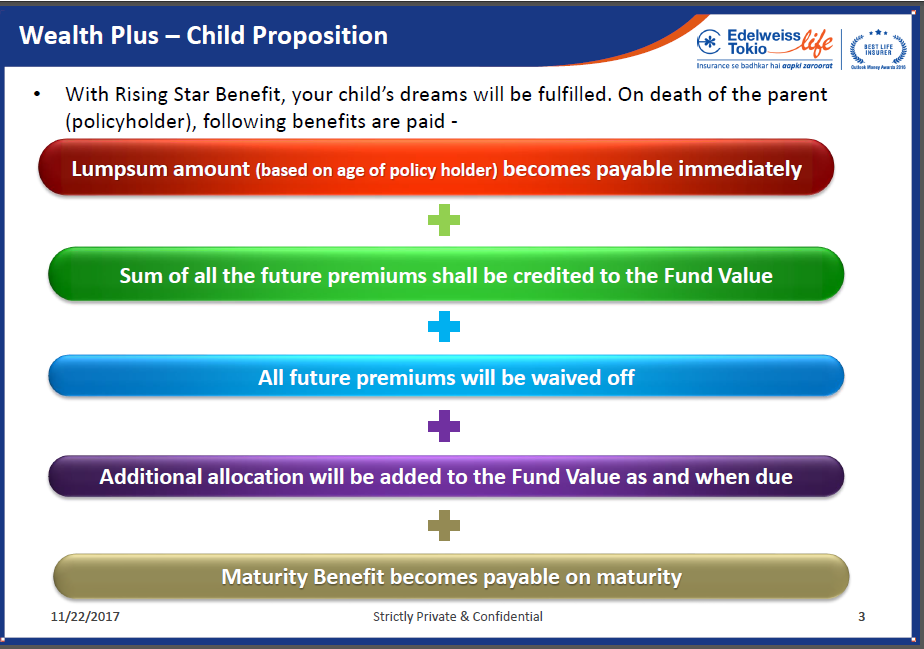
Rising Star Benefit
The best part of the plan is their Rising Star Benefit. While it is a long-term commitment, one may choose it for protecting their child’s future. In this option, both the parent (policy holder) and child are insured.


Who Should Buy this Product?
It is important to know what are you buying and why. This is a great investment product if you have a long-term commitment and minimum Rs. 48,000 a year. This plan is a great buy for goals like child education or marriage plan or retirement. To make maximum of this insurance plan, start early and choose the 20 years premium term and 20 years policy term.

What is in it for the Insurer?
One should ask this question to oneself when any investment offers return higher than usual industry standards. In the current scenario, ULIP charges 3-5% on the investment yearly to manage various expenses like management fees, brokers/agents, marketing channel, and even customer acquisition activity, paperwork, etc. To minimize the cost, Edelweiss has come up with a win-win situation; they are rewarding the customer for continuing investment for 20 years, by incentivizing them with extra units every year - 1% for the first 5 years, 3% from the 6th to 10th year, 5% from 11th to 15th year, and 7% from 16th to 20th year. This means, the longer you invest, the higher the percentage loyalty addition you get.
Through this plan, the insurer is able to give the best in class return as they reduce customer acquisition cost. It is only available online on Policybazaar and Edelweiss Tokio website.


Friday, June 16, 2017

Waiting Period in health insurance policies


#Icici Lombard #Apollo Munich #Hdfc  ergo
In past I have written about Top 10 common exclusions in health insurance policies, In this post I would like to bring to your notice about the #waiting #period in any health insurance policy. With  series of new and old health cover plans in this category from basic to elite health plans, health insurance companies design the health covers keeping in mind the cost it needs to bear the risk. More the risk for the company more will be the premium for the product. Companies decides health insurance rates depending on the health cover as well as the individual's health profile. So, while buying a health policy, choosing the cheapest option available may leave you in a lurch as it may have maximum exclusions and waiting period. Unlike features, exclusions and waiting periods are stuffed in the terms and conditions section and only available in the download section at the bottom of the insurer website. Pull that out. 

Especially if you have certain medical conditions or have a family history of certain health issues, it would be prudent to check the waiting period segment very carefully.


What is Waiting Period in health insurance policies?
Insurance policies come with waiting period clause, which is nothing but the length of time within which you cannot claim any/ certain benefits of the policy. Even if you have to undergo certain treatment/ hospitalisation, the insurance policy will not cover the expenses. The waiting period can be put under three categories - initial waiting period, pre-existing ailment waiting period and disease-specific waiting period.

Initial Waiting Period
This is for the first term buyers of the insurance policy. In this, if policyholders fall sick within 30-90 days of buying the policy, insurance companies don’t cover varying in each policy. However, in the case of hospitalization or medical expenses arising due to an accident, the policy is valid.

Pre-existing disease
If the policyholders have pre-existing medical conditions like diabetes, hypertension, Thyroid etc. Any ailment related to these or mentioned in the contract of the policy will have a certain waiting period 1-4 years to get the insurance benefits on the treatment. However, any other medical treatments will be covered during this period.


Disease-specific #waiting period
Any medical expenses arising from specific diseases listed in the policy document under this head would not be settled by the insurance company within the said period. The common disease under this categories are – arthritis, cataract, kidney stones etc.
#waiting period in health insurance is equally important aspect as exclusions

Waiting period for maternity cover - Many insurance policy doesn't cover maternity in the benefits list as it is not an emergency. However, few company offers it as fixed benefit plan as an additional option within the health policy fir extra premium. However, maternity benefits plan have a waiting period of 9 months to 48 months. So, buying policy early in life can help get this benefit as well. 

Insurance companies are in business of risks. They cover Medical expenses risk for a fraction as a premium. The under writing team develop the products after assessing the on their profitability and ensures that the have to settle least of the claims. However, it doesn't mean we stay away from buying health insurance, it is about taking informed decision and not choosing the cheapest product available in the market without comparing.


Stay healthy. Buy a good insurance product which suits your current health Profile, family history and offer adequate protection.


#
#Icici Lombard #Apollo Munich #Hdfc  ergo

Please share if you like